Weather

MARYVILLE, MO KE0SBX QTH
Showing posts with label SSB. Show all posts

Thursday, July 18, 2024

My Thoughts on Citizens Band

 So I'm not one for making opinion posts...but...

I want to make it clear - CB radio is what got me into ham radio. I remember going down to clean out our basement one day when I was about 10 and I stumbled upon a bluish-grey metal box with a mic coming out of it. It was a Roadmaster (Royal Sound) RE4000 CB radio - and it changed my life forever. And for all you CBers reading this post - I hope that I can speak for all of you...

Wednesday, April 12, 2023

Easter Activity 2023

 Hi everyone, long time no see as usual.

Well, the semester is winding down finally, I've got about 2 or 3 weeks of school left. And boy, do you know what I'm doing once I get out of here... at least for the summer.

Over the Easter weekend, I thought I'd take my FT-891 and Chameleon TD LTE antenna out for some activation. We had Easter at my dad's family's in Bethany, Missouri (if you don't know where that's at, it's east of my QTH off of I-35). My young and curious cousin, Alex, also tagged along. He is into CB radios right now so I figured I'd expose him to ham radio while I was over there.

Alex seemed pretty interested while setting up my antenna and putting together my radio. While setting up, he asked how big the antenna was, and I told him 120 feet. Surprise was an understatement - he couldn't believe that there was an antenna that long! My grandparents had an old windmill about 10 feet high, so I mounted the center near the top using some paracord. It seemed to work fine and I might use it again if needed.

Monday, February 06, 2023

Yaesu FT-891: Best for the Budget?

Okay, so maybe my base rig needed an update too. I get it; there are not enough options for someone on a budget like me, and unfortunately, ham radio isn't a budget hobby. Don't get me wrong, I LOVE my TS-660, but there's just something about not having 80, 40, or 20m access that makes hams grumble when you're trying to set up a sked or a QSO. Building QRP equipment is great, but 9 times out of 10 you'll be limited to CW-only designs (in addition to Feld Hell, too!). Most hams don't do CW or even Feld Hell, so you're left calling CQ for ages if you use those modes.

In 2016, a miracle happened. Yaesu unveiled a new radio capable of producing 100W out on SSB, CW, and FM (and 40W on AM, if you care!). The best thing about this rig was its size - anyone could take it anywhere, no matter the circumstances, and even if you had a bare minimum wage-paying job, HF would be within reach. Thus, the FT-891 was born. Styled like its predecessors, the FT-817/818, it packed more punch than any mobile rig of the same size could. And if you're worried about being badged "Made in China," don't worry - it's actually made and imported from Japan, where electronics of quality are born.

I remember when I got licensed in 2018, just 2 years after the reveal. I can vaguely remember me trying to save money for a bigger and badder radio than any other ham out there. Unfortunately, it didn't happen, but I did get my TS-660 and prior to that, I was given a SK's Yaesu FT-2200, one of the best 2m radios I've owned. There is no comparison between it and the Baofeng. Period.

Background on the Purchase

For a little under $700, I went ahead and took the plunge and bought the FT-891. Before I bought it I read through the reviews and every website gave it 4.8/5 stars. The number one complaint (minimal complaint) was the controls - the radio has a lot of menus to go through but I don't think I'll find it a problem.

I ordered from Ham Radio Outlet again since I have had nothing but excellent service. The MSRP was $639.95 without tax - even with tax, it still didn't break the bank like I thought it would. The package arrived within two days, which is REALLY fast although it came from the HRO store in Milwaukee. 

Initial Thoughts and Unboxing!

I went ahead and unboxed the radio which I must say was packaged pretty well! In the box, I got the radio, the faceplate, the microphone, the power cables, and some hardware for mobile mounting. I did have to resurrect my Pyramid 30A PSU, which actually wasn't too bad for the little rig! The moment I turned it on, I noticed little to no switching noise - obviously this has a built-in PSU filter. 

I actually didn't mind having to step through the menus, and after enough practice, I think I know my way around this radio already! Unfortunately, I did run into some problems.

The FT-891 does not have a built-in sound processor like some of the higher-model radios, but it does have CAT control. I also realized that in order to use my LDG auto-tuner, I needed a special 3.5mm plug - oops. But in all reality, I don't mind. I still have my Easy Digi board and I can choose to control the rig via CAT or an RS232 breakout board. Looks like a custom interface is in the works for the future!

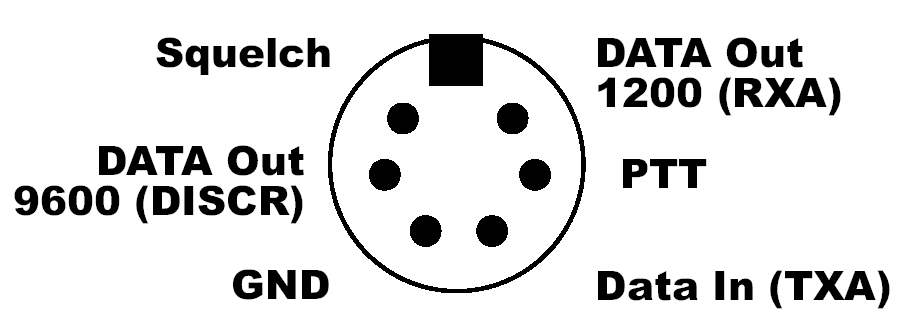
I tried using the SignaLink, but to my dismay, it only transmitted audio - it did not have any sound going to the computer. Yaesu did put a data interface on the back of the radio. It is a 6-pin, mini-DIN connector, like what you'd find on old computer mice or keyboards. If you have any old ones laying around, consider scrapping the cable - it should work! Below is the pinout:

Facing the back of the radio, the only pins we need to focus on are the DATA Out (Audio TO Radio), PTT (or if using the built-in CAT, ignore this!), DATA In (Audio FROM Radio), and GND (Ground). While I won't go into detail, KM4NMP has an excellent write-up on making your own interface, minus the PTT/CAT control. Just plug in the radio via the USB port in the back, configure your software, and go! Make sure to also adjust ALC levels so you're not overdriving the radio! 

Closing Thoughts and Recommendations

I absolutely love this radio and to be unbiased and honest, I have no critical complaints. I think that this radio would be an excellent starter radio. It can also be used as a base station or you can go portable, much like its predecessors, the 817, 818, 857, etc. With 100W of output, you are more than guaranteed to work the world wherever you are.

I would certainly recommend this radio to someone who's on a budget. It's a good radio whether you're new to the hobby or an operator who's seen some action. If QRP just isn't cutting it for you or you're constrained to only 2 or 3 bands, consider getting this radio. With some extra circuitry, this radio can run FT8, PSK31, Feld Hell, RTTY, etc. On the flip side, if you do enjoy QRPing, this radio can lower power levels down to 5 watts.

Conclusion and updates

For the record, I STILL cannot get RBN spots in the south despite putting out significantly more power. I'm trying to get to Alabama, but no cigar. I am clear from coast to coast, but it appears that no one down there reports me or can't hear me. It may be time for a new antenna setup, particularly one that points south. Better yet, I NEED MORE SPACE! Do you know how horrible it is to have your entire station antenna set up on less than a tenth of an acre, let alone indoors???

The weather up here in Maryville is starting to get warmer (hopefully it continues to!), and today the temp is about 52 degrees. I'm starting to get back into the swing of things at school and summer can't come soon enough! 

Once I get an extended break (in about 4 weeks or so), I plan on taking my radio out to the university and will hopefully make some contacts. Until then, I'm bound to the books for now...

Sunday, January 29, 2023

A Great Day for Ham Radio

Yesterday couldn't have gone any better than it did - I made two SSB contacts using only 10W of power and a wet noodle!

The first station I called was a special station. K3S is based on the world's first nuclear-powered boat, the Savannah. Savannah is currently docked and decommissioned near Baltimore, Maryland, and is recognized as a National Historic Landmark. According to the K3S QRZ page, January 28th is a significant day:

"Radio Operator Jack Binns sent a CQD (former SOS) message from [the] RMS Republic on January 23, 1909, after Republic was rammed by the Italian liner SS Florida. Republic subsequently sank, but Binns' CQD and continuous wireless work [resulted in] a successful rescue of all aboard except two killed in the collision."

It took me 3 tries to get through to K3S. The station's operator was Ted and he gave me a much-improved signal rating of 5x3. He was coming in around 5x8 or so. It was really amazing to work this station due to the special occasion, but at the same time, I also was just scanning around the bands. K3S held a QSO with me on 21.3137.

Later, towards the end of the day, I called CQ on 15m again. As soon as I sent out my third CQ call, N1IIC came right back. Fortunately, he told me that I was extremely modulated, which means my mic gain was too much. It's not very nice to overmodulate, so I turned it down. I guess you really don't need that much mic gain even for 10W. He came in at a 5x5. N1IIC QSOed with me on 21.3680. We had a good talk, I told him where my QTH was at and that I had been hearing RTTY on every band I was on. January 28th was also when the British Isles were hosting a RTTY contest, which took over almost every band. It's so beautiful to hear so many RTTY stations.

In addition to this, I will be updating my station (again!) with another radio provided by HRO - the Yaesu FT-891. If you haven't heard the news already, Yaesu is discontinuing the FT-817/818 line of radios. This looks like a good replacement for the cost as you will get 100W out in a smaller package. 

Until then, stay tuned for a review!

Thursday, September 22, 2022

Crossing the Pond on 10W and a Prayer

We did it, I officially crossed the pond today! And I learned some valuable lessons along the way.

I came home from school to eat lunch and figured that I should operate on 15m for a while. Lately, 15m has been super active, so I figured I should throw out my callsign to see if someone came back. I heard a few people collecting callsigns, so I waited to send mine out until I was confident that's what they were doing. One station, in particular, was IK4GRO in Northern Italy. I'm not quite sure what he was running but I was getting 5x8 and 5x9 signals on my meter. 

After waiting a few minutes, I threw out my call. Nothing. I tried again, but still nothing. After a dozen or so tries of trying to break through the QRM and QRN, I got through. Unfortunately, he got my callsign wrong, but that's expected since I was QRP. Instead of KE0, he got KE1. I let it go for a while before throwing my call back out.

After 5 or 6 tries, I got through! I got a 4x4 report and I gave him a 5x8 report. Not bad for a contact I had been hoping for for a long time!

Of course, I learned a lot just from this single contact, and I'd like to share that with you...

1. Patience is everything!

It took me dozens of tries to get through to IK4GRO. It wasn't easy. Sometimes, you just have to persist until they hear you. A 4x4 report means that I could be heard with a little noise at an S4 or so on the meter. On QRP, you will have to try harder to make contacts.

It may take you 1 call or maybe 50 calls, but you will eventually get through. On other occasions, you might have to give up and move on. It's all part of the fun!

2. Get a good antenna

Okay, hams are all about amplification, but in theory, an antenna makes the difference. Amplifiers don't add much, maybe only half or up to 1 S-unit. That would've only gotten me to S5 - not much of a difference.

I ordered a tactical antenna from HRO which I plan on taking to the field. Speaking of the field, that's the next tip I learned.

3. Get out of the house!

Find a place where there are little to no buildings and obstructions. You'll want some trees to mount your antenna in. Try to find a place that is elevated, flat, or near water (water is a good reflector!). I have many places around where I live to go out and operate QRP. 

Here's the other perk - you get to go into the great outdoors and enjoy some nice weather! You might walk into one of your friends and start a conversation. I have found that the more I talk to my friends about it, the more interested they seem. Had I gotten out of the house today, I hypothetically think my signal report would've been better.

4. Time of day matters

My TS-660 is a daytime radio - that means that it will only work from a bit before sunrise to a bit before sunset. I'm gone during the day so I don't get much action unless I listen to stations on my shortwave receiver. For the past week, I have listened to 15m via my shortwave, and I have heard at least 100 stations over the past week or so. This was all done around 2 or 3pm in the afternoon. 

5. A decent microphone works best

Stock microphones aren't bad, but they're basic - a condenser and a PTT button. Higher-end microphones have everything from preamps to audio filters. It's not really necessary but it might help. I found myself cupping the mic constantly trying to get the best acoustics for my voice. 

I have several more lessons that this contact taught me, but these have got to be the most important ones. I also want to say thanks to IK4GRO for calling me back despite operating QRP and the QRM that we experienced. Although I got a 4x4 rating today, it's better than not getting a call at all. 

Many, if not all hams say that 10W SSB is impossible. Today, I did the impossible and defied the odds. I wonder if this is how Marconi felt when he made the first radio transmission...

Here's a Snapchat video clip of the signals I received from IK4GRO today on 21.332.8MHz:

Until next time, I'll see what else this great little rig can pull off!

Friday, August 26, 2022

An analysis of the 15, 12, and 10-meter bands

 Do you ever wonder if there's any ham that's not on 80, 40, or 20 meters? I sure do, especially since I mainly do my work on 15, 12, and 10 meters. I have the capability to do 6 but I don't have the tuner (hooked up, at least) yet to access this band. After about a year of on and off operating, here's my analysis of the only bands I can access at the moment. I'm capped at 10W, so this could affect my signal strength and what my experiences are. 

15 Meters

15 meters is the most busiest band by far that I've heard. It's mainly stateside or contacts in the Caribbean or South America. Most traffic is FT8 or Morse but I've heard the occasional RTTY or CW from W1AW. I've also heard the fellow operator many times in the house who goes by the name Kenmore. Up to this point, this is the only frequency band that I've made successful contacts on and they've only been on FT4 and FT8. 

I'd like to do more though. I have thrown out dozens of CQ calls on voice, RTTY, PSK31, and even Feld Hell, but to no avail. There are frequencies for these modes, but they're dead all the time. I have been spotted several times but no one comes back to me on these modes. It got me wondering if it could be my antenna setup, or maybe it's because my entire setup is inside. 

12 Meters

12 meters is a nice band and because it's a WARC band, it's a safe haven from contest pileups. Yes, there are data and voice segments. I rarely hear traffic on this band, but during contest season, it piles up fast with people who are non-contesters. I've mainly heard voice, the occasional CW, and FT8 on this band.

Although it's a small band it's still useable, but not for me. Unfortunately, my antenna tuner refuses to load my EFHW under a 2:1 SWR without compromising power. It's just impossible! Maybe an auto tuner or different antenna can solve the issue???

10 Meters

Many amateurs report that this band is littered with stray CB operators, but from what I can tell, this band is pretty dead. Except for FT8, which is still far and few between, there is nothing here where I'm at. It's kind of sad because Technicians have the capability of using the 10m band for SSB voice and most are excited to get this privilege on HF. Unfortunately, I've not heard a single voice on this band in the entire time that I've owned and operated this radio.

10 meters is also VERY susceptible to changing solar conditions, even more sensitive than the other HF bands. Perhaps the solar weather isn't the best right now?

What should you do?

Keep calling. When I ran FT8 the first time, I had to call 15 times before someone came back to my CQ call! Given my current rate, I'd be calling CQ forever before someone came back to me on voice or RTTY. Just because the band seems quiet doesn't mean it's dead - someone could be listening for a CQ call to answer, you just never know. There are plenty of skimmers on PSKReporter and RBN, but unfortunately they only look for CW and RTTY CQs. They claim to look for PSK31 but so far I haven't seen anyone spot my PSK calls.

You could also consider increasing your power but the magic in ham radio is doing more with less, at least I think so, so I'd strongly discourage amplifier use. In fact you're required to use the minimum power necessary to carry out a contact. If 10W can do it, use 10W. If you need 50, use 50. I'm looking at getting a Yaesu FT-891, but I think I'll wait until conditions (economic conditions, that is) improve. Better yet, you could update your antenna system. You'd be surprised how well an antenna improves your signal and station setup. I run an EFHW random wire throughout the top of my room. It tunes up well, but I'm sure a dipole would do me wonders. I could probably load easier it on 12 meters, too. For starters, placing my antenna system outside would definitely change things.

Although I think it's kind of cheating the system, ask another ham friend that lives a state over for a QSO and test how far you can go. Or you can try spotting yourself on an SDR. I've tried this and I've heard my own RTTY signals being sent, with the SDR station near Washington, D.C.. I'm sure I could hear myself sending FT8, but that's impossible to confirm.

If you're in town, consider moving to a less dense area like a park. My radio is large, but I'm sure I could take it anywhere and I'm sure it would fit on a picnic table with ease. Where I live, I have a university that I attend with lots of trees and open space - perfect for mounting a simple dipole and making some contacts!

Other things or "lurking variables" could hinder your station performance. Such things include RFI from appliances and power supplies (it's real, believe me. And yes, do yourself a favor and buy a linear or battery supply!!!), current weather and solar weather conditions, and so much more. As I've mentioned before, ham radio is one large and ongoing science experiment that we all take part in. 

I hope to make some contacts on other modes. FT8 is great but it's gotten a bit too boring for me. If you'd like, tune to the 15, 12, or 10m bands - you might just find me there!

Hope to hear you down the log! 

Wednesday, February 02, 2022

How to operate QRP: A partial guide

It's so much fun to operate ham radio when your on about 50W of power. Unfortunately, the cost of a 50W, let alone a 100W transceiver, is astronomical. Luckily, there's a solution: QRP. The world of low-powered radio communication is full of endless possibilities. With activities such as POTA (Parks on the Air), SOTA (Summits on the Air, usually done from a mountaintop), or even QRP clubs, the world of less than 5 watts is limitless. Unfortunately, low power comes with the consequence of low power. Sometimes, you'll fruitlessly call CQ for an hour with no response, or you'll succumb to QRM, or really bad interference. But don't let that scare you away, as QRP can be really fun! It's all part of the challenge.

As a QRPer myself, I like to build radios, and that's where QRP becomes an art and a trade. QRP rigs are often simple to understand, comprising of at least two transistors. The infamous Pixie kit is a fine example of QRP. Simple to build and easy on the pocketbook, this small radio only outputs around 500mW up to a watt with only two transistors. 

So how does one begin to operate a QRP station? In this post, I'll explain a few simple steps to get started.

Thursday, December 16, 2021

Easy-Digi Digital Interface

 Do you have a radio that you want to run digital modes on? That's great, but you know that you don't want to spend hundreds of dollars on a sophisticated interface. Let's face it - a soundcard interface is made up of audio transformers and a way to key your rig, so why pay more for something so simple?

I want to talk about the most simplistic interface board ever created. It's so simple that one could even homebrew their own! It's the Easy-Digi interface, available on eBay. This neat little gadget is sold by KF5INZ on eBay for a VERY reasonable price. The board is easy to follow and can be wired up to your satisfaction and need.