Weather

MARYVILLE, MO KE0SBX QTH

Monday, February 06, 2023

Yaesu FT-891: Best for the Budget?

Okay, so maybe my base rig needed an update too. I get it; there are not enough options for someone on a budget like me, and unfortunately, ham radio isn't a budget hobby. Don't get me wrong, I LOVE my TS-660, but there's just something about not having 80, 40, or 20m access that makes hams grumble when you're trying to set up a sked or a QSO. Building QRP equipment is great, but 9 times out of 10 you'll be limited to CW-only designs (in addition to Feld Hell, too!). Most hams don't do CW or even Feld Hell, so you're left calling CQ for ages if you use those modes.

In 2016, a miracle happened. Yaesu unveiled a new radio capable of producing 100W out on SSB, CW, and FM (and 40W on AM, if you care!). The best thing about this rig was its size - anyone could take it anywhere, no matter the circumstances, and even if you had a bare minimum wage-paying job, HF would be within reach. Thus, the FT-891 was born. Styled like its predecessors, the FT-817/818, it packed more punch than any mobile rig of the same size could. And if you're worried about being badged "Made in China," don't worry - it's actually made and imported from Japan, where electronics of quality are born.

I remember when I got licensed in 2018, just 2 years after the reveal. I can vaguely remember me trying to save money for a bigger and badder radio than any other ham out there. Unfortunately, it didn't happen, but I did get my TS-660 and prior to that, I was given a SK's Yaesu FT-2200, one of the best 2m radios I've owned. There is no comparison between it and the Baofeng. Period.

Background on the Purchase

For a little under $700, I went ahead and took the plunge and bought the FT-891. Before I bought it I read through the reviews and every website gave it 4.8/5 stars. The number one complaint (minimal complaint) was the controls - the radio has a lot of menus to go through but I don't think I'll find it a problem.

I ordered from Ham Radio Outlet again since I have had nothing but excellent service. The MSRP was $639.95 without tax - even with tax, it still didn't break the bank like I thought it would. The package arrived within two days, which is REALLY fast although it came from the HRO store in Milwaukee. 

Initial Thoughts and Unboxing!

I went ahead and unboxed the radio which I must say was packaged pretty well! In the box, I got the radio, the faceplate, the microphone, the power cables, and some hardware for mobile mounting. I did have to resurrect my Pyramid 30A PSU, which actually wasn't too bad for the little rig! The moment I turned it on, I noticed little to no switching noise - obviously this has a built-in PSU filter. 

I actually didn't mind having to step through the menus, and after enough practice, I think I know my way around this radio already! Unfortunately, I did run into some problems.

The FT-891 does not have a built-in sound processor like some of the higher-model radios, but it does have CAT control. I also realized that in order to use my LDG auto-tuner, I needed a special 3.5mm plug - oops. But in all reality, I don't mind. I still have my Easy Digi board and I can choose to control the rig via CAT or an RS232 breakout board. Looks like a custom interface is in the works for the future!

I tried using the SignaLink, but to my dismay, it only transmitted audio - it did not have any sound going to the computer. Yaesu did put a data interface on the back of the radio. It is a 6-pin, mini-DIN connector, like what you'd find on old computer mice or keyboards. If you have any old ones laying around, consider scrapping the cable - it should work! Below is the pinout:
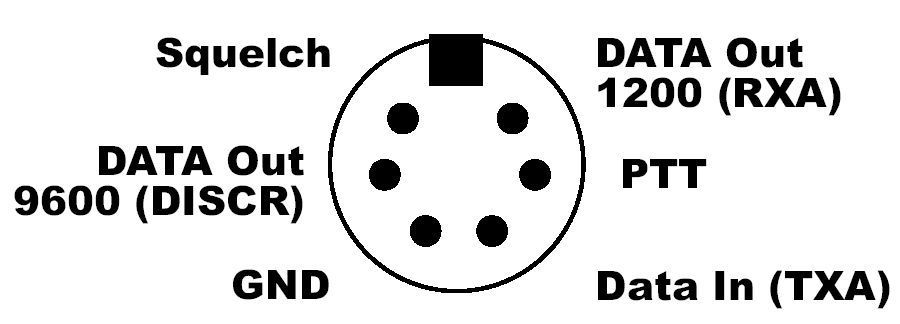
Facing the back of the radio, the only pins we need to focus on are the DATA Out (Audio TO Radio), PTT (or if using the built-in CAT, ignore this!), DATA In (Audio FROM Radio), and GND (Ground). While I won't go into detail, KM4NMP has an excellent write-up on making your own interface, minus the PTT/CAT control. Just plug in the radio via the USB port in the back, configure your software, and go! Make sure to also adjust ALC levels so you're not overdriving the radio! 

Closing Thoughts and Recommendations

I absolutely love this radio and to be unbiased and honest, I have no critical complaints. I think that this radio would be an excellent starter radio. It can also be used as a base station or you can go portable, much like its predecessors, the 817, 818, 857, etc. With 100W of output, you are more than guaranteed to work the world wherever you are.

I would certainly recommend this radio to someone who's on a budget. It's a good radio whether you're new to the hobby or an operator who's seen some action. If QRP just isn't cutting it for you or you're constrained to only 2 or 3 bands, consider getting this radio. With some extra circuitry, this radio can run FT8, PSK31, Feld Hell, RTTY, etc. On the flip side, if you do enjoy QRPing, this radio can lower power levels down to 5 watts.

Conclusion and updates

For the record, I STILL cannot get RBN spots in the south despite putting out significantly more power. I'm trying to get to Alabama, but no cigar. I am clear from coast to coast, but it appears that no one down there reports me or can't hear me. It may be time for a new antenna setup, particularly one that points south. Better yet, I NEED MORE SPACE! Do you know how horrible it is to have your entire station antenna set up on less than a tenth of an acre, let alone indoors???

The weather up here in Maryville is starting to get warmer (hopefully it continues to!), and today the temp is about 52 degrees. I'm starting to get back into the swing of things at school and summer can't come soon enough! 

Once I get an extended break (in about 4 weeks or so), I plan on taking my radio out to the university and will hopefully make some contacts. Until then, I'm bound to the books for now...

Friday, February 03, 2023

The Zip Wire/KG6HQD Speaker Wire Antenna

 Do you have some old speaker wire laying around? Don't have an antenna for your QRP or full-power rig? Is the RTTY contest just 2 hours or less away and you're panicking because your antenna broke or is out of commission???

Well, don't worry, because today, we're going to be building the Zip Wire antenna! This antenna has been around for a while and was popularized by KG6HQD (SK). I went back on YouTube and found the video where Jerry builds his antenna and demonstrates it. If you have some speaker wire, one of those balun adapters (like a BNC to screw terminal type), and some extra time, you can get on the air in no time!

Antenna Theory and Math

The first question you might be asking is, "why does this antenna not have any coax?" Well, it's actually quite simple. This antenna is configured in two pieces - the elements and the feedline. The feed line is built into the antenna elements, which acts as a balanced feeder.

For the first equation, we will focus on the elements, which follow the conventional 1/4-wave equation:

234/f

Where f is the frequency in MHz. This will give a final result in feet. For me, my frequency is 14.060, which results in just under 17ft. For now, I'll cut to the nearest foot and trim later.

Now, we'll focus on the feedline. The equation will look like this:

492/f * (vF)

Where f is the frequency in MHz and vF is the velocity factor. A velocity factor is a comparison ratio between a medium and the speed of light. For speaker wire, 0.7 (70%) will work for vF. My equation results in 24.5 feet. In total, I will need 41.5ft of speaker wire.

When you're done, tie a knot at the point where you measured your antenna elements. Start splitting the wire down the center up to the knot. When you've completed this DON'T SPLIT ANY FURTHER! Tie an electrician's knot, as displayed here:

Pull your ends tight, add some insulators to the end, cut your antenna to resonance, and you're done! Just add a screw terminal BNC connector and you're done!

The complete Instructable for this can be found here: https://www.instructables.com/No-Solder-Easy-Speaker-Wire-Dipole/.

I'll post photos later, I've gotten busy again and need to attend to school for a bit now. Until next time, 73s!


Sunday, January 29, 2023

A Great Day for Ham Radio

Yesterday couldn't have gone any better than it did - I made two SSB contacts using only 10W of power and a wet noodle!

The first station I called was a special station. K3S is based on the world's first nuclear-powered boat, the Savannah. Savannah is currently docked and decommissioned near Baltimore, Maryland, and is recognized as a National Historic Landmark. According to the K3S QRZ page, January 28th is a significant day:

"Radio Operator Jack Binns sent a CQD (former SOS) message from [the] RMS Republic on January 23, 1909, after Republic was rammed by the Italian liner SS Florida. Republic subsequently sank, but Binns' CQD and continuous wireless work [resulted in] a successful rescue of all aboard except two killed in the collision."

It took me 3 tries to get through to K3S. The station's operator was Ted and he gave me a much-improved signal rating of 5x3. He was coming in around 5x8 or so. It was really amazing to work this station due to the special occasion, but at the same time, I also was just scanning around the bands. K3S held a QSO with me on 21.3137.

Later, towards the end of the day, I called CQ on 15m again. As soon as I sent out my third CQ call, N1IIC came right back. Fortunately, he told me that I was extremely modulated, which means my mic gain was too much. It's not very nice to overmodulate, so I turned it down. I guess you really don't need that much mic gain even for 10W. He came in at a 5x5. N1IIC QSOed with me on 21.3680. We had a good talk, I told him where my QTH was at and that I had been hearing RTTY on every band I was on. January 28th was also when the British Isles were hosting a RTTY contest, which took over almost every band. It's so beautiful to hear so many RTTY stations.

In addition to this, I will be updating my station (again!) with another radio provided by HRO - the Yaesu FT-891. If you haven't heard the news already, Yaesu is discontinuing the FT-817/818 line of radios. This looks like a good replacement for the cost as you will get 100W out in a smaller package. 

Until then, stay tuned for a review!

Thursday, January 26, 2023

A Word Of Caution When Making PCBs

I had a bit of a health scare today but I think I'm alright.

I had to re-mix some copper chloride etchant since my old stuff wasn't strong enough and had lost its potency. Since I was in a hurry, I bypassed wearing a mask and it may have cost me big time. The minute I opened the muriatic acid, I was greeted with some chlorine fumes, and needless to say, I panicked for quite a bit. I actually fell backward out of fear of poisoning myself. I bet I must've looked stupid!

Luckily, I was doing this outside, but I still caught a whiff of the fumes. I am okay right now, just a bit concerned that I may have done some damage.

If you are making PCBs in this way, PLEASE wear the proper PPE. This includes a mask, eye protection, long-sleeved clothing, and gloves. You could actually poison yourself without realizing it, at which point it may be too late. 

And as always, don't rush production. It's how mistakes like this are made.

This friendly PSA was provided by KE0SBX's ham shack. Stay tuned for more and stay safe out there! Hopefully, I'll return with my Feld Hell interface up and running on the Cub...

One other thing about this solution: This stuff really starts to lose potency after a week or so of sitting in a plastic tub. Despite putting copper in it to agitate it, I think the best solution would be to use a small water pump, like what's in an aquarium. Amazon sells mini ones for under $10. If you have a strong arm, you can also stir it using a plastic fork or spoon, but this may take forever. Once the solution has oxygen introduced to it, it will start to regain its potency. 

Friday, January 20, 2023

My CW Journey So Far (and a bit of WSPR...)

We're Making Progress!

I have started making progress on at least one of my New Year's resolutions, and so far I must say I'm making great progress! Unfortunately, it's just trying to find the time with my busy schedule. 

As of right now, I can send A, B, C, D, E, I, K, M, N, O, P, Q, R, S, T, U, and X, all at or around 10 wpm. Not bad, not bad at all! I have come across times where I will get N (-.) and A (.-) switched around. I do know, however, that K (-.-) is the inverse of R (.-.), and I guess N would be the inverse of A. If you can think like this, then Morse will be a breeze for you.

Another thing that has helped me is learning dits and dahs. I know, you're going to sound stupid saying it, but it is worth it and it will help you! If you memorize the characters by sound (bee-beep) versus dit-dah (di-daht), it will be much harder for your to process a message.

How do I (you, the reader) get started, then?

A few posts back, I mentioned the website LCWO.net. It costs nothing to join and will teach you Morse via the Koch method. The key (no pun, hihi) is to practice as much as you can in a set time frame. You're not practicing for time's sake, you're practicing for accuracy's sake. For me, I take at least 30 minutes out of my day to practice a lesson or two. I practice each lesson 3 or 4 times for repetition and muscle memory. 

To practice sending, consider making a practice oscillator. You can use anything - a 555 chip works best for the heart of any practice oscillator. If you're not the DIY kind of person, MFJ sells an oscillator with an added bonus straight key! I have used one of these at Scout camp and I must say that they are good to work with.

The key that I'm using is a 3D-printed key that I found on Thingiverse. You can find it here. This works well, but what if I'm out and about? To solve that, I "remixed" a key to suit my needs. The knob is shaped like the old army keys but it is small enough to carry with you in your POTA, SOTA, or QRP bag. That link is here. If necessary, I'm sure one could even use this as their base station key if so desired.

When you think you're ready for an on-air QSO, send out a quick CQ call. Either one of two things will happen: You'll get an answer or you'll show up on the Reverse Beacon Network. The RBN is a great tool to show you where you're more than likely to get contacts. With my MFJ Cub, I was heard over 800 miles from my QTH, which is pretty impressive just for 1-ish watt of power. In comparison, my TS-660 could be heard as far away as Costa Rica and the Canary Islands!

My perception of CW has changed drastically since I first became a ham. I always thought that getting an SSB contact across the world was impressive, but sending a signal comprised of dots and dashes that can reach anywhere is even more impressive - just the fact of "talking" in a different "language" is wild enough. The pure fact that some of these CW radios that are on the air right now are homebrewed is even more bewildering! 

In conclusion, I think I'll be using CW later on in my ham radio career once I'm proficient at it. I'm sure I'll be able to complete my resolution by the end of the year at this rate. But now, as Monty Python puts it, it's time for something completely different...

WSPR

I'm sure you've used FT8 at some time in your life. Well, WSPR is no different! WSPR stands for Weak Signal Propagation Reporter and was developed by Joe Taylor, K1JT, the same fellow who developed FT8 and WSJT-X. Not sure where your signals could go? Try your hand at WSPR!

WSPR is comprised of a 50-bit messaging system. It includes your callsign, maidenhead locator, and the power output of your rig in dBm. For example, my WSPR stream would look like this: <KE0SBX EN20 40>. WSJT-X features a built-in version of WSPR and you can transmit worldwide at any part of the day. The farthest I was heard was in Austria, almost 5000 miles away! I ran WSPR on 15, 12, and 10 meters, all with success. 

WSPR tells us many things. It tells us possible paths where our signals could go, who can hear us, and how propagation is.

If you have an SSB rig, go ahead and give WSPR a try. Trust me, you'll be surprised with the results. Spots are posted to wsprnet.org and are updated constantly. Just type in your callsign in the search and watch how many people spot you. It truly is a great mode to use and it gives us hams a tool to use for propagation.

That's all for now, hope to hear you on the air! 73s!